Genesis, Part I of Idolatry

Genesis, Part I of Idolatry

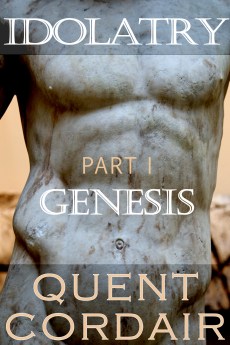
Genesis, Part I of the Idolatry series, is the first segment of an epic tale told in five parts. The story begins in the twilight of the Roman Empire as a sculptor struggles to keep an 800-year dream alive while honoring the love of his life and raising his adoptive son….

*  *  *

CHAPTER 1

THE BOY WAS STANDING on the summit of the hill above her, the spring grasses waving at his feet, his white tunic carving clean against the azure sky. He was waiting for her, hands on his hips, smiling his irresistible smile. She ran up the hill to join him, her feet barely touching the ground.

Whether she had fallen or knelt when she reached him, she neither knew nor cared – the musky scent of his sandal leather mingled with the pungency of the earth between her fingers and the sweetness of wildflowers twining through her hair. She lifted her eyes to follow the arching line between his bare shin and supple calf, the skin as smooth as polished marble. A soft wind pressed the folds of his tunic against his thighs, hollowing a vale between them. His hands were asking for hers – her fingers were found and encircled by the warmth of his own. She hadn’t realized how cold hers had been. From her knees, she studied the knot of his belt until, as he raised her to her feet, her gaze was drawn upwards to his chest, to his lips, into his eyes – eyes that were shining orbs of hazel agate flecked with umber and gold, rimmed in moss green. Her gaze flitted from one iris to the other, marveling at the minute differences between them, delighting in the detail, while his eyes studied her own, penetrating more deeply –

“Sira . . .”

Her name came on the breeze dancing through his bronze curls, a dark-flamed corona pierced through with brilliant rays from above.

“Sira . . .”

She was too close to his lips – she didn’t dare look at his lips, though the heat of his breath was between her own. She gasped as he lifted her into his arms and began to spin her slowly around, and as the heavens turned above his head, she fell deeper and deeper into eyes from which she could conceal nothing, wanted to conceal nothing. He was breaking through every barrier within her and soon would know everything –

“Siranush!” Her mother’s voice snapped her back into the present.

The cacophony of the bazaar rose in Sira’s ears, the babel of voices climbing and tumbling, the clangor of copper pots and bronze ware, the clinking of silver coin. From the street came the bleating of goats and sheep, the crack of the crop against an oxen’s dusty flank, the grind of wooden wheels on paving stones.

She blinked and regarded the length of fine white wool in her hands: it was the same swath of fabric she had been folding when left in charge of their stall by her mother, now returning, with her basket filled with fresh chickpeas, ripened olives, dried apricots, mint sprigs and flatbread.

“Less dreaming, Sira. More selling.”

Sira sighed and pressed her nose into the piece of bread her mother had torn off for her, still warm from the oven. The figs and cheeses of the farmer in the stall adjacent were beginning to tempt – either would be good with the bread, both would be better. She tried not to look at them. From the stall opposite, the fat Phoenician who sold donkey saddles was still leering lasciviously, while his wife, not more than a teenager herself, glared daggers at the younger girl from around the edges of her veil. Sira closed her eyes. The vision of her lovely young god had slipped away like a startled stag into the forest.

She scanned the heads of the crowd in the bazaar, searching for the boy’s curls – but today, he was nowhere to be seen.

Checking her reflection in the polished bronze hanging from the tent pole, she tucked an unruly wisp beneath her plaited braids and adjusted her ivory hairpin. With eyes as large as dates, their irises as dark and richly shining as her hair and lashes, she had learned to use her other gifts judiciously. A mere hint of her smile was usually more than sufficient to secure all the attention she might desire, and often, unfortunately, more.

That morning she had donned her coral-colored tunica and belted it with her favorite sash, a brilliant blue silk from the distant East, trimmed in gold brocade and embellished with six pairs of finely embroidered birds that flitted and played across the blue silk sky. While her family was far from wealthy – over the years, privation had too often been the unwelcome guest at mealtimes – Sira had always been allowed to select her apparel and accessories from the best of their inventory: the better she looked, the more she sold, and today, she had never looked better.

She could feel no guilt over the daydream. That morning she had already sold more fabric and cookware than the rest of her family had sold the whole of the week before. Her brother had disappeared again, to gamble with the boys in the alley; her father was likely sitting under a tree or leaning against a wall somewhere, exchanging news and gossip or bartering with the craftsmen and other traders for new stock. It mattered little to him what the goods were, as long as they were of good quality and saleable at a profit down the road. Every few days or weeks the family would break down their tent, pack up their wagon and join another caravan, to travel the old Roman roads to the next town that would accept them. From Constantinople to Antioch, from Ephesus to Neocaesaria, in towns large and small across the breadth of the Eastern Empire, Sira had sold kitchen utensils, aphrodisiacs, buttons, brooches, goats, carved wooden boxes, spices, honey, scented oils and ceramic pots. She hated selling dried fish. She loved selling textiles, clothing and jewelry. The trove of fine silk her father had acquired for a pittance from a cash-strapped Sogdian trader was a rare treat, by far the best fabric yet to pass through her hands. Her enthusiasm for the luxurious textures and rich colors was infectious to prospective buyers.

Or to most of them. Yesterday, she had been attempting to accommodate a fussy man who was flipping through her fabrics dismissively, disheveling her carefully folded stacks, mussing the samples hung neatly from the cross poles, complaining that nothing was quite the right hue and finding flaws and imperfections invisible to mere mortals. She had been on the verge of asking him if his mother had had the same keen eye, and if so, why she hadn’t traded him away as a child to the slavers for a couple of chickens, all things considered, when she glanced up to see – the boy.

He was standing in the middle of the street, staring at her intently, looking as if he had just found something he hadn’t realized he had lost. Pedestrians detoured around him. Cart drivers cursed him. How long he had been standing there watching her she didn’t know. Casually, she brushed her fingers through her hair: the fresh white lily she had tucked there that morning was still in place.

By the time the fussy man had moved along to be disappointed by the farmer’s fruits and cheeses, the boy was walking away, nearly out of sight.

Sira had thrown a quick excuse to her mother and followed him.

She trailed him through the bazaar and beyond, into the town’s central square, in the middle of which was an elaborately carved marble fountain. As the boy passed it, he touched his fingers to his lips and raised his hand in a saluting kiss.

Sira hadn’t ventured as far as the square before, her family having arrived in town only a few days earlier. As she neared the fountain, she found herself slowing.

It was hardly the largest or most ornate fountain she had ever seen, and she had seen many in her travels, yet the more closely she approached, the more captivated she became. Its lower tier was composed of four remarkably lifelike elephants, facing the four winds, water spouting from their trunks, each creature captured in its own motion and mood. The southerly elephant was stomping in agitation, trunk cocked high and to the side. The easterly animal was bracing defiantly, head lowered and ears back, trunk pointing outwards. She circled to the northerly creature, who bore its burden with resignation, its trunk swinging low. The westerly elephant was the youngest of the four; it seemed eager to trot away at the first excuse, ears perked and flapping happily. She thought the elephants magnificent. She wanted to name them all and feed them and ride the youngest to the sea, where they would sit together in the sand and eat pistachios and watch the waves for hours on end.

The elephants were positioned between four columns, each of which was exotically adorned with bundles of reeds, Egyptian motifs, and capitals of palm fronds. A herd of small antelope peered out from around the columns. Some nibbled on the reeds; others drank from the fountain’s pool. The elephants and columns supported a wide, spouted bowl, around the rim of which lounged the figures of three graceful girls of about Sira’s age: one lay prone, her chin resting on her clasped hands as she admired her own reflection in the water below; another was supine, her leg bent and raised at the knee, her arm hanging loosely off the side of the bowl’s rim, her face to the sun; the third was sitting with her knees drawn to her chest as she contemplated the fountain’s central figure, which stood majestically on a stepped circular dais rising out of the upper pool.

The rendering of the elephants, the antelope, and the three girls was so masterful as to be nearly beyond Sira’s ability to grasp or accept. Surely these living, breathing beings had been turned to stone in an instant by the Gorgons and they would spring to life again the moment the spell was broken. But when her gaze had risen to the top tier, she felt as if she herself might have come under the Gorgons’ spell: her feet were rooted to the spot where she stood. She couldn’t take her eyes off of the figure of the woman above.

At any moment, the woman’s name or title would spring to mind. Sira was certain she recognized her – yet, she couldn’t remember. . . . She was a great queen, or the wife of a dignitary Sira had met, or a distant relative, or a friend of her mother’s – but no, perhaps this was a goddess of whom Sira had not yet heard. . . .

The stone of the fountain was unblemished, practically new by all appearances, barely weathered – which struck Sira as strange: she realized she had never before seen freshly carved, new sculpture in the round. Apparently, it just wasn’t being done anymore. She thought to ask her father why this was so, why the only other such sculptures she had seen, save for the occasional frieze on a government building or mausoleum, was weather-beaten, crumbling or partially destroyed, why it was that the beautiful fountains and statues were always old, deteriorating and historical – relics of the past – and how it could be so, when this could be done? The fountain was perfect and gorgeous and young and uplifting, as fresh and bright as the dawn after a rain-washed night.

Scattered about its lower rim were offerings of flowers and fruit, but there was no clue to the figure’s identity, no identifying prop or symbol. The woman was dressed simply but elegantly in the classic tunica, stola and palla. An exposed swath of the tunica, from the shoulder to the waist, was so sheer and revealing that the woman may as well have been partially nude – the nipple of her right breast and her navel were clearly visible beneath the transparent stone fabric. Flanking the figure, on the steps below, were the figures of two young boys, one sitting, the other kneeling, each holding a tilted amphora from which water flowed and converged to cascade down the steps and into the pool below. The woman wasn’t tall, yet she seemed to stand taller, and more comfortably so, than any sculpted figure Sira had ever seen. Her chin was lifted slightly, arms held loosely to her sides, hands relaxed. She was regal yet approachable, worldly wise yet light of spirit, nothing more and nothing less than a woman standing in the place where she stood, the whole of the earth as her kingdom and home. Sira found her enchantingly beautiful, shiningly intelligent, passionately feminine, faultlessly virtuous – all that a girl could want to see, all that a girl could want to be.

For Sira, it was turning out to be a most extraordinary and wondrous day, and in such a remote, nondescript town, no less. When her family had entered the town’s gate, the place had promised nothing beyond the ordinary, and now she felt as if she were falling deeply in love for the second time within the hour, first with the boy, and now with this woman –

The boy . . .

She caught a glimpse of his curls disappearing into a street off of the far side of the square. She groaned, hesitated and, taking the white lily from her hair, laid it next to a blue lotus flower that someone had left next to the fountain’s lower bowl. She looked up to the woman again, longing to spend at least a few moments more with her. She could have stood there forever. “Wait here,” she said, and she ran to follow the boy, laughing as she realized she had just spoken aloud to a statue of stone and, moreover, had told it not to move.

Read more…

Genesis cover art 051115c

50 reader reviews; 4.9 out of 5 STARS….

How’s Your Tuesday Going?

How’s your Tuesday going, in this beautiful land of the free? For one American, who happens to draw cartoons for a living, dawn came today with the knowledge that he’s targeted by men willing to die in the effort to murder him. How’s your Tuesday going, in this beautiful home of the brave? Listen keenly for a few moments to those likely innocent sounds outside. Was that a rake someone dropped? A package being delivered? The sudden firing up of a leaf blower. A car engine getting louder as it approaches but then doesn’t fade. A car door shutting, perhaps a little too quietly… The unidentified bump from somewhere beyond the side wall, the light scraping near the front door. The doorbell ringing. The shadow of what was probably just a bird across the closed curtains. How’s your Tuesday going?

You need to go shopping. You stop and listen carefully before opening the door. It has to be done. You can’t stay inside. You won’t. You scan the bushes, the street, each parked car, each pedestrian—as nonchalantly as you can. You’re brave. You won’t show fear. Outside the grocery store, a young man who might be Muslim stands, waiting for someone perhaps, watching as you approach, his hand in his pocket. You nod at him as you pass, to see if he nods back. How’s your Tuesday going? Back home, you turn on the TV. Most of the wagging heads are implying that it will be your own fault if you’re murdered—you’ll have had it coming to you, for having drawn a cartoon, for having put lines on paper, for having expressed your honest opinion about an ideology, for having stood up against that which you know to be wrong. And you realize that the wagging heads on TV want to be proven right. They’re waiting for it.

How’s your Tuesday going, in the land of the free, the home of the brave, in the United States of America, where you never imagined you would be left unprotected by those who swore to uphold the Constitution, where you never imagined you could be left exposed and abandoned to die on an altar to someone else’s vengeful god, awaiting only the priest with the knife to arrive. But there’s no schedule for the sacrifice. Only “soon,” they say. How’s your Tuesday going?

Separation of religion and state is no more, when the state looks away as one of its citizens is sacrificed to appease a god’s anger. Religion rules once more. How’s your Tuesday going? They came for the cartoonists, but I was not a cartoonist. We’ll go about the day as we did the day before. We’ll show solidarity, if and when it happens, by changing our profile pic for a few days to a black background with “I am XYZ” in solemn text. We’ll share a clever, poignant graphic or two. Life will go on. For some of us.

How’s your Tuesday going?

‪#‎IamBosch‬

Fawstin

A special story for Mother’s Day…

A special story for Mother’s Day…

On this Mother’s Day, I offer my short story, “For the Woman Who Has Everything,” from the Lunch Break collection.

“Sarah woke to silence. Thin lines of moonlight lay in diagonals across the floor. She listened for awhile. The only sound was the soft rustle of her hair against the pillow.

“She slid her legs from beneath the layers of blankets and let her feet touch the chill of the hardwood floor. As she walked, a line of moonlight slipped around one ankle, then the other, ascending, scanning and measuring her body in strict undulations. At the west window the moon caught her fully, a slender white animal beneath the new winter’s sky….”

The Enemy of the Good

The Enemy of the Good

Half the town, it seemed, was gathered at the door, peering in, peeking over shoulders, querying, feral rumors slinking around the edges while, closer to the front, more respectable theories were being advanced in hopes of winning a laurel of knowledge for the price of a guess. But no one knew. Mr. Henkle was one of the most dependable, successful men in town, having led the seemingly perfect, enviable life, with the business, the home, the wife, the kids. Never a whisper of trouble. The news was unsettling, inexplicable. The world was no longer right. Everyone liked Mr. Henkle. He had always made sure of even that….

Read more….

In response to the Charlie Hebdo attack, I’ll be making the script for “Mujahid” available free of charge for 24 hours, starting at midnight Pacific tonight. In the story, Islam is explicitly invoked and resisted during a planned terrorist attack by the Islamic State. Prior to midnight, “Mujahid” remains available through Amazon at the usual price. Your assistance is appreciated in spreading word of the script to the corners of the earth. Freedom of speech must be upheld and defended. Let’s try to get this film made. http://www.amazon.com/dp/B00R8QP8NI

A call for courage

A call for courage

I urge my fellow writers, artists, musicians, performing artists, producers, directors, distributors—all those involved in the arts—to respond with courage, disdain, and the passion of Cyrano against those who would silence us. The war against freedom of expression is one of dynamic momentum, in which we are either advancing or retreating. Do not imagine that the enemies of freedom will cease attacking if only we’ll shut up and be quiet. Silence buys the artist nothing but self-censured, empty hours until the day he is either forced to serve the censors’ ends or be killed if he refuses. The enemies of freedom cannot afford to back down and remain passive while we in the West are allowed to express our ideas and views as we freely choose. Freedom is the totalitarians’ worst enemy, and they will continue attacking freedom and freely expressed ideas until they win or are forced to back down. Stand now, artists, and speak up–by doing what you do best, without restraint, and demanding that your freedom to do so be adequately defended–or watch in shame and regret as the generation of artists that follows is forced to kneel in silence.

Note to those in elected positions in the U.S. government: either act to protect our freedom of speech or look for other employment. Upholding and defending the freedoms guaranteed to your constituents in the U.S. Constitution and the Bill of Rights–this is your first and primary job. If you fail to do your job, those in the arts can be quite persuasive. That’s our job. We only ask that you stand with us and for us as our fellow Americans: speak up in defense of our speaking up, and support forcefulness against those who would use force against us. That’s all we ask. That’s all we need.

In “The Match,” Elizabeth thinks that her boyfriend, the detective, may be ready to propose, but when conversation takes an unexpected turn, she must decide how much to reveal about a collection of books and an encounter with the law on a night when life and death hung in the balance.” Now available @  http://www.amazon.com/The-Match-ebook/dp/B00CTWYBKC 

Reviews of Cordair’s short-story collection, *Lunch Break*:

“The stories are full of beautiful lines, priceless events, and unexpected plot twists – from a meaning-packed ‘I can and I do’ in ‘A Prelude to Pleasure,’ to a knee to the groin in ‘The Seduction of Santi Banesh,’ to countless others that I dare not mention for fear of robbing you of the pleasure of reading the stories yourself.” – The Objective Standard

“Could you read these during your lunch break? Yes. Will you want to? No. You won’t want to rush yourself. You’ll want to pour yourself a glass of wine, snuggle into your favorite chair, turn off your phone, and spend every luxurious minute that you can immersing yourself in these stories.” – Elizabeth O’Brien, author of English Grammar Revolution

“…well worth the price. If you haven’t read any of Quent’s stories yet, I almost envy you. I’m waiting eagerly for more.” – Dianne Durante, author of the Forgotten Delights series

“…it is fuel for the spirit; it is an affirmation of life and what is good. That he writes beautifully and imaginatively adds to the reading pleasure.” – Michael Wilkinson, Sculptor

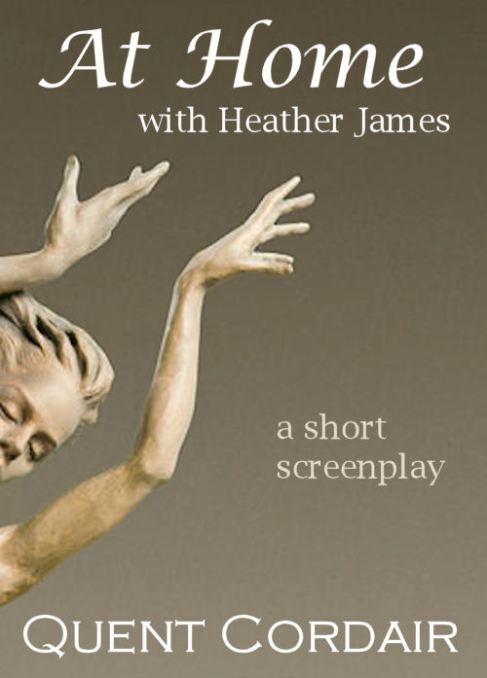
I’m very pleased to share with you a newly released story on Kindle, a 30-minute screenplay I wrote in 2001. I still love the story, and it deserves to see the light of day rather than remain tucked away in a box. I hope you enjoy “At Home

with Heather James.”

“The sparks fly when movie star Rex Keller is the special guest on Heather James’ talk show. As the handsome heartthrob and the smitten host preview the clips for the actor’s new film, the heat rises, and by the end of the show, Heather is made an offer she can’t refuse. Or can she . . . ?”

http://www.amazon.com/dp/B008ZFYXIC

Image

*Lunch Break* Collection now available!

*Lunch Break* Collection now available!

The *Lunch Break* collection of my short stories and poems is now available on Kindle @ http://www.amazon.com/dp/B008B0KXFI

“A selection of short stories and poems by acclaimed writer Quent Cordair from two decades of early work, including stories originally selected for publication by *The Altantean Press Review* and *ART Ideas.*

Selected Stories — “A Prelude to Pleasure,” “April’s Justice,” “The Whistler,” “The Seduction of Santi Banesh,” “For the Woman Who Has Everything,” “The Sculpture That Won the War,” “The Hunter” and “Sheltered.”

Selected Poems — “My Pledge,” “Holding Your Hand,” “The Line,” “Your Hands,” “Priceless,” “In My World,” “Suite Boxes,” “For My Softest One” and “Clever Girl.”

Three of the stories, “A Prelude to Pleasure,” “The Seduction of Santi Banesh,” and “Sheltered” are available separately for Kindle. “Sheltered” is additionally in paperback.

“Written with an engaging voice and a masterful control of language, this powerful short story delivers a meaningful message…” – Michael Alger, review of “Sheltered,” Kindle edition.

“A beautiful, innocent young girl discovers this-worldly values and makes the most important decision of her life. That’s about all there is to this story, and yet it is a delicious pleasure to read. Cordair’s descriptions of the city, his insight into the various psychologies of the characters, his metaphors, and especially his admirable heroine, all combine to take the reader on a joyous journey of discovery, right along with Santi. The ending is one of the most perfect I’ve ever encountered, summing up the benevolence of the whole experience with its simplicity and inevitability. Cordair has seduced me – his is the type of world that I choose to live in.” — Amy Mossoff, review of “The Seduction of Santi Banesh,” Kindle edition.

“I read this story during recovery from a painful hip fracture and found it so absorbing that it took my mind off the post-operative pain. So perhaps one way of praising it would be to say, ‘it’s better than Percocet’!” — Paul Hsieh, review of “A Prelude to Pleasure,” Kindle edition.

“This short story was delightful to read. In contrast to the dull, prosaic prose of so much fiction today, Cordair beautifully paints for the reader the psychological state of a man driven by fear and how this manifests itself in his life. The progression of events is logical and the ending of the story is ultimately fulfilling in the sense that when the inevitable turn of events unfold, the reader is left with the thought that, given the nature of the characters and their circumstances, this is how it ought to have been. Moreover, Cordair seems to have a gift for grasping exactly how much detail a reader needs of an environment and of a character, such that the story comes alive and is engaging, but I never once felt like I was forced to read unnecessary facts that are irrelevant to the plot. After reading this book, I immediately purchased on my Kindle his other short story, A Prelude to Pleasure, and I’m looking forward to his release of his full-length novel.” — Adam Mossoff, review of “Sheltered,” Kindle edition.

“I enjoyed this very much. The less I say in this review, the better. I wouldn’t want to steal any of the pleasure that comes from reading it, being drawn in, liking some characters, disliking others, cheering some on and sometimes being moved to tears. Enjoy!” — Sal Durante, review of “A Prelude to Pleasure,” Kindle edition.

“With imagination and story-telling skill, Quent Cordair weaves an exquisite tale that leaves the reader wanting more.” — Michael Wilkinson, review of “The Seduction of Santi Banesh,” Kindle edition.

“What a wonderful journey….! Amazing job of character development in such a short story. An entertaining read with a great message about priorities and values. Read it, you won’t be disappointed.” — John Cerasuolo, review of “Sheltered,” Kindle edition.

Purchase the paperback edition, or download your Kindle copy today

@ http://www.amazon.com/dp/B008B0KXFI

Sheltered

Sheltered

“A year and six days underground without sunlight or breeze or contact with the world above—whatever might be left of the world above. A year and six days without touch, without unrecorded voice, without contact, without friends or family. If only they had listened, if only they had been ready. But he—he had prepared. He was Reginald B. Wakefield, and he hadn’t died. A wave of vindication washed over him, lifting and sweeping away all doubt and fear. He had been right. He raised his eyes again to the hatch cover above. . . . He had been right.”

In “Sheltered,” the timely and popular short story by Quent Cordair, a man follows his own course in response to fears of impending disaster and societal breakdown.

The story is included in the *Lunch Break* collection of short stories and poems, now available on Amazon.

“I’m amazed how much this story has stuck with me over the past month! Usually, I’m all for the bright and cheery in pleasure reading, but these characters are so exquisitely drawn that I delved right into their less playful world. The author does a beautiful job of addressing the real life issue of objectively assessing risks via the actions of characters that feel equally real. It’s a powerful story worth reading!” — R. Miner

Enjoy now in paperback or on Kindle…