Burning the flag and other sacred things . . .

Burning the flag and other sacred things . . .

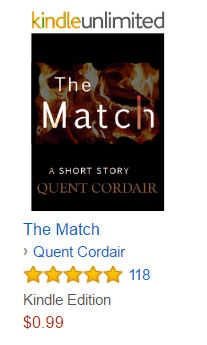
In light of the flag-burning statement by the president elect, I’m making my short story THE MATCH free to download for 72 hours, through Saturday, midnight Pacific. In the story, several items are intentionally burned — items even more sacred to many Americans than the U.S. flag. Should such actions be outlawed? Many would say “yes.” In the protagonist’s situation, what would you do? (The Kindle reading app is free to download to any device too.) ~ https://www.amazon.com/The-Match-ebook/dp/B00CTWYBKC

113016a

The Whistler

The Whistler

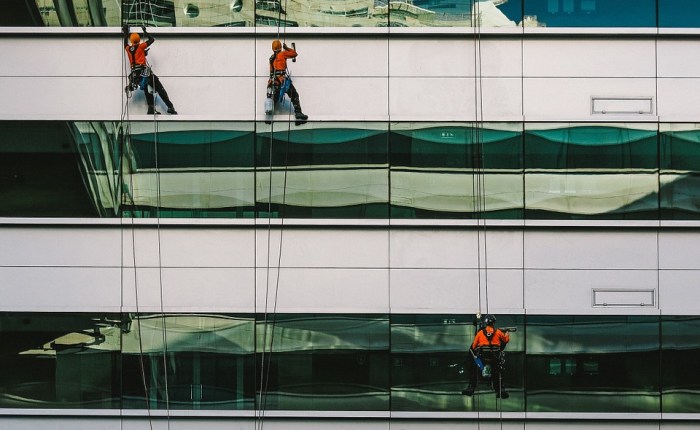
IN THE MIDDLE OF THE PLAIN, as though hewn from a mountain of crystalline quartz, rose the city’s sun-dazzled facets of towering glass. From the top of the tallest came a sound, a sparkling cascade of notes. The window washers were preparing their scaffolding for the day’s descent. One was whistling a symphony. The other two engaged in conversation.

“First day, huh, kid? What’s your name again?”

“Bobby. Yours?”

“Walt. So what did you do to deserve this? Parents finally kick you out of the house?”

“No, I’m saving money for school next fall. Besides, I like the view.”

“School? Ha. I’ve got a degree in psychology, and look where it got me.”

From the other end of the scaffolding, the whistler nodded a greeting while continuing to check the cables and connections.

“Who’s he?” Bobby asked.

“You don’t recognize that face?” Walt lowered his voice. “Well, it’s been a while, I guess. See that gold-colored building over there?” He tilted his head toward the city’s second tallest tower. “He used to sit in a plush corner office on the top floor. That man was once the president of his own bank – and now he’s washing the windows on one. He’s the biggest failure this side of the Mississippi.”

“Damn.”

As the platform lowered over the edge, the symphony segued into a melody that had once serenaded cattle on the rolling prairie below, the notes lofting into blue space.

“So, what happened to him?” Bobby asked.

“He made a bad decision, ran into some bad luck. The bank went under.”

“Oh.”

Three floors lower, a mockingbird landed on the platform’s railing. It cocked its head at a Viennese waltz and flew off in search of less formidable competition.

“Why didn’t he start over or go into some other line of business?”

“With what? Every penny he had was backing that bank. His credit is shot. Up there on the north side, he had a twenty-room mansion, four cars, a yacht, a summer home in the mountains. Now he rents a room down near that factory by the rail yard; he walks to work, doesn’t have so much as a bathtub to play in, and he hasn’t taken a day’s vacation in the two years he’s worked here.”

The waltz shifted into a lilting ragtime tune, the first of a dozen that carried them down the next seven floors.

“Does he have family?”

“His wife took the kids. The relatives who once basked in his glow now cross the street to avoid his shadow. One of his brothers even changed his last name.”

A series of Baroque canons and fugues accompanied them down to the building’s halfway point, where they paused for lunch. After eating his sandwich and tucking away the brown bag, the biggest failure this side of the Mississippi laid back on the platform to watch the clouds, whistling a soulful slave hymn.

“Surely he still has a friend or two,” Bobby ventured. “If the decision was just an honest mistake and the circumstances were unforeseeable, he would still have the respect of his peers. Somebody would give him a chance at something. . . .”

“People want him around like they want a black cat named Thirteen. If whoever is in charge of this place ever bothered to read the applications for window washer and discovered that bad luck incarnate is hanging on the side of their bank, they’d probably cut the cables we’re dangling from rather than waiting for us to come down.”

As the afternoon passed, a lively march reverberated from the surrounding buildings, followed by an operatic aria and a program of buoyant show tunes. The sidewalks began filling with people on their way home. A sweet lullaby floated down. A few glanced up appreciatively.

“Well, at least he seems happy,” Bobby said.

“At first I thought he’d taken this job just to have a convenient place to jump from, but then he started with that infernal whistling and I knew he’d lost his mind. The only future the man has is the hope of being back up on top of this godforsaken pile of glass tomorrow morning.”

An Irish ballad set them gently on the sidewalk.

“Hey, you – the whistler.” A man in a business suit beckoned from a bench next to the taxi stand.

“Here, this is for the music,” he said, holding out a five-dollar bill and patting the spot beside him. “Sit down, sit down. . . . Nobody whistles like that anymore, you know. My father was a whistler though. God, could he whistle. When I asked him to teach me how, he said, ‘Son, you have to start with a clean conscience.’ It took me a long time to understand that, but he was right. He was the most indomitable man I’ve ever known. I’ll never forget, when I was seven years old a tornado destroyed our house and the farm. My father led us up from the cellar, took a long look around, and as he tossed a twisted piece of our plow aside, he started whistling. I only remember a little of the tune. It went – La, dah dee dee, la dah, dah dee la . . .

The whistler’s whistle picked up the melody and carried it high into the glass canyon.

“Yes! . . . Yes, that’s it. . . .”

*         *         *

The next morning, on the top floor, there were only the two window washers cleaning the panes.

Walt exclaimed, “Come here, kid, look at this!” His face was plastered to the glass. “Now I know what happened to him – he got himself fired. That man, the one he was talking to, he’s the bank president!”

Bobby went and looked, and returned to his own side in a thoughtful melancholy. He wiped a swath through the dust on a window and stopped, peering into the office next to the president’s. The well-dressed man sitting at the desk was cleaning a smudge off of the glass top with his handkerchief. On the front of the office door, someone was lettering a name in the space above the words, “Vice President.” The only sound outside was the wind, but the man at the desk was undoubtedly whistling. Recognizing Bobby, he waved. Bobby waved back and finished cleaning the window.

As the scaffolding lowered to the next floor, Bobby shaped his mouth in the form of an “O” – and blew.

*         *         *

*

First published in 1994 by the Atlantean Press,  The Atlantean Press Review.

Copyright 1994, Quent Cordair. All rights reserved.

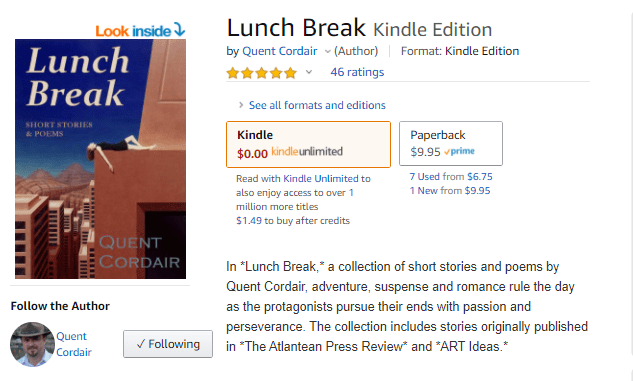
“The Whistler” is included in the Lunch Break collection of short stories and poems, available through Amazon in paperback and for Kindle @ http://www.amazon.com/dp/B008B0KXFI .

The Sculpture That Won the War

The Sculpture That Won the War

From a letter to a sculptor
Sept 27, 2001

ONCE UPON A TIME, there was a sculptor who had only the face to finish of a magnificent statue, his masterpiece to date. Frustrated by his limitations and increasingly dissatisfied with his efforts to bring into existence the perfection in his mind’s eye, his progress on the artwork had foundered and stalled. His workshop had fallen silent. Indeed, as the days and weeks and months drifted on, the statue was in danger of never being finished at all.

But on a crystal-clear morning, a morning seemingly as peaceful as any other in living memory, a shocking event occurred: the sculptor’s country came under attack. It was a morning of sudden and unexpected terror, of cold-blooded murder that left thousands dead and the populace reeling.

Over the next days and weeks, a miasma of insecurity and anxiety settled over the land, ubiquitous and inescapable, visible on the faces of the rich and the poor, the young and the old, the strong and the weak, the eminent and the obscure. Their sense of wellbeing had vanished overnight; their paradigm had shifted, ostensibly forever. In response to the attack, some wanted to stand and fight; others wanted to kneel and plead; most wandered through their hours fearful and confused, unsure of what to do. While the government drafted plans for war, the citizenry went about their daily routines as well as they were able, anxious for what the fractured future might bring for themselves and for their loved ones, wanting to do something, anything, to combat the pervasive sense of helplessness, yet uncertain of what, if anything, could be done.

The sculptor knew that his country was in greater need than ever of emotional fuel, and he knew what could help provide it. His country was fighting for her life—she needed vision and inspiration to survive, to defend herself, to remember what she had once been, to conquer, to rebuild, to thrive once again. With renewed vigor and determination, he threw his efforts into doing what he could do, contributing with what he did best. Days and nights, coffee and curses, dejection and perseverance, but finally—satisfaction, satisfaction that he had done what he could do, as well as he could do it.

Within a few weeks of the enemy’s strike, the sculptor sent his finished clay to the foundry; within a dozen weeks thereafter, the foundry delivered the finished bronze to the gallery; the gallery, in turn, delivered the artwork to the client who had commissioned it.

The delivery brought in the balance of payment to the gallery which, due to the widespread economic uncertainties subsequent to the attack, was on the brink of closing for lack of sales. The buyer, upon receiving the sculpture, was so delighted with the finished work that he was motivated to place yet another significant commission with the gallery, and the deposit toward the new commission kept the gallery open for a few precious months more. Over that period, the economy stabilized sufficiently that regular purchases began to trickle in again, just enough that the gallery would never again be quite so close to failing.

In the spring after the sculpture was completed and delivered, an eight-year old girl was passing by the gallery with two of her friends. Upon catching a glimpse of the art on display in the window she drew her friends inside, and as they browsed the cornucopia of treasures within, the girl stopped before a lovely figure, a bronze sculpture patined in white. It was a smaller casting of the sculptor’s larger masterpiece. She fell in love with it, and she was all the more enchanted and delighted when she discovered, upon reading the tag at the artwork’s base, that she shared the sculpture’s name. She could hardly afford the sculpture itself, of course, but she spotted a photographed image of the piece framed and hanging on the wall nearby. It too was available for purchase. She checked the price—she couldn’t afford the photograph either. But she did have five dollars. She approached the gallery manager to offer what she had, wondering, hoping. The manager dug through her filing cabinet and found, from a recent mailing campaign, a postcard that featured an image of the sculpture. She gave it to the girl, smilingly, without charge. The girl went home and slipped the postcard into the edge of the mirror on her bedroom wall.

*    *    *

A young pilot cruised silently through the cold night sky, the diamond dust of stars twinkling above. The blanket of clouds below stretched ahead toward a rumpling rise in the distance, marking the boundary of mountainous terrain beneath. His sortie consisted only of himself and his wingman, in two stealth fighters. According to the screen in front of him, they had just crossed the border into enemy territory. It wouldn’t be long now.

The mountains ahead bristled with anti-aircraft batteries.

War had been declared on those who had supported the terrorists and their atrocious acts. The ground war was proving more difficult than anticipated, with the enemy forces scurrying back into the crevices and caves of the mountains at the slightest provocation. The enemy’s military leader, the very swine who had devised and overseen the terrorist attack, was proving elusive, but a disillusioned member of his inner circle had been susceptible to bribing, and the leader’s location had been leaked. The caves in which he was thought to be hiding and their surroundings had been bombed incessantly over the past days, and on this evening, an intelligence satellite had picked up a small convoy attempting to leave the area under the cover of darkness. A forward spotter on the ground confirmed that it was indeed the enemy leader, who could disappear into another system of caves within minutes or hours.

The jets had been scrambled immediately, and now the pair were within a short thirty miles of their target. They rolled onto their sides and slipped like diving nighthawks through the clouds and to the height of the peaks before turning into a craggy-walled valley. By design, the cutting-edge craft were nearly undetectable by radar, but a watchful enemy soldier, at first spooked by the two shadows streaking silently above, frantically radioed ahead a warning. Anti-aircraft fire began tracing upwards, trying to catch the fleeting apparitions. The pilots dropped lower so as not to offer a silhouette against the night sky. Without warning, a missile from below caught the wingman’s craft, and it erupted into a comet of flame, dropping away without so much as a sound from the pilot’s radio.

The young pilot who remained fought to stay focused. All of his reflexes wanted to pull the stick back and shoot straight up to the sky, to rise above the fiery tracings that would surely find him too at any moment, to live to fight another day.

Deep in the canyon, radio reception was intermittent and broken. He might have heard his commander’s order to pull up and out, but he might not have heard it either. If he climbed, he might be able get a fair shot at the convoy from altitude—if he survived the incoming fire to which the altitude would expose him—but it was the enemy leader himself, the black heart and soul of the enemy forces, who was traveling in that convoy. When would there be another chance if the pilot missed or if he were shot down before being able to make another attempt? How long might the war drag on if the leader escaped? The images that had been seared into his memory on that accursed morning came again—the hijacked airliners crashing into the skyscrapers, the innocents plunging from the heights to their deaths, the buildings collapsing, the vacant despair on the faces of the survivors.

He thought of the postcard in the breast pocket of his flight suit, of the delicately looped handwriting in violet pen on the postcard’s reverse, of the girl who had sent the accompanying letter. He switched off his radio. Steeling himself, he kicked the plane over on its side, banking hard around a canyon corner, flying lower yet, the bullets from small arms pinging into his craft’s underbelly.

The infrared radar confirmed the vehicles of the convoy on the road ahead, speeding toward a pass so narrow that even if he were on his side he wouldn’t be able to follow them in. He dropped lower, the dust from the road boiling in his wake. Either of the laser-guided bombs on board would get the job done, but he wouldn’t be able to gain enough elevation in time to guide one in on the first pass, and he wouldn’t be able to complete a second pass before the convoy scattered.

He hadn’t even met the girl. She was a student in a class of fourth graders that had adopted his unit. They had sent a package of homemade baked goods and letters. Her envelope had found its way onto his bunk just the evening before. The letter opened with the generically respectful “Dear Sir—” He recalled the words written on the back of the enclosed postcard and the tiny violet heart after the girl’s name. On the front of the postcard was the image of a sculpture, the embodiment of innocence and delight. It was the only mail he had received in weeks. It was enough.

“Okay, baby, this one’s for you. . . .”

He armed both of the bombs and aimed the nose of his black angel at the rear vehicle in the convoy ahead. In his final seconds, he thought of the target, of the enemy leader, and realizing something, he chuckled. With the fire of hell in his eyes, he said, “Live by the plane, die by the plane, mother f—”

*   *   *

On a cloudless morning in the thin mountain air, an American soldier walked through the scattered wreckage at the site of the strike. Pieces of wood, metal and clothing were scattered about the perimeter of the blackened gouge in the road, three hundred yards long. It would go down in history as the place where the head of the hydra was killed and the tide of war had been turned. The platoon was combing through the wreckage for any of what might remain of the leader’s papers and effects. Of the pilot’s body, they hadn’t been able to find anything, though small pieces of the plane were identifiable here and there. But the oddest scraps can survive such conflagrations: after the attack that had brought down the buildings and started the war, one of the terrorists’ passports had been found in the rubble below.

The soldier lifted a piece of twisted metal and noticed in the ashes beneath it a postcard, its edges curled and seared brown but otherwise unburned. On the front was the photo of a sculpture, an elegant figure in white, beckoning to be followed into a world of wonder and happiness. The soldier smiled. He turned the photo over and read: “Dear Sir, this is how I used to feel before the war. I hope I can feel this way again someday. Thank you for fighting for me. — Joy”

The soldier tucked the photo into his breast pocket and slung his rifle over his shoulder. Kicking aside a half-burned turban, he walked down the road and took in a chestful of clean air. For the first time in months, he allowed himself to think of home.

* * *
*

“The Sculpture That Won the War” is from
The Lunch Break collection of short stories and poems ~
available in paperback and Kindle editions.

“…well worth the price. If you haven’t read any of Quent’s stories yet, I almost envy you. I’m waiting eagerly for more.” – Dianne Durante, author of the *Forgotten Delights* series

“Could you read these during your lunch break? Yes. Will you want to? No. You won’t want to rush yourself. You’ll want to pour yourself a glass of wine, snuggle into your favorite chair, turn off your phone, and spend every luxurious minute that you can immersing yourself in these stories.” – Elizabeth O’Brien, author of *English Grammar Revolution*

“…it is fuel for the spirit; it is an affirmation of life and what is good. That he writes beautifully and imaginatively adds to the reading pleasure.” – Michael Wilkinson, Sculptor

Enjoy more of my poetry & short fiction in my latest collection, My Kingdom, now available in paperback and Kindle editions. ~

I could not put the book down! I read the poems out loud to my kids as though I am Cyrano on stage! Inspires me to be the best I can be! Love it! ~ Heather Pendaris

If you enjoy life and a positive view of mankind, if you are a valuer and enjoy reading uplifting works, you’ll love this collection of short works by Quent Cordair. This is a great book when you just want a short read that will leave you feeling better than when you started, when you need a little emotional fuel. No need to read it as a whole, just enjoy a little morsel when you need it. You will find yourself going back for more, over and over. I have thoroughly enjoyed Quent’s longer works, but they are a deeper dive. This collection can be enjoyed even if you have only short spurts of time available for reading. I highly recommend it. ~ Steve M.

I can only say, if like me you admire human independence and have a belief that each of us are sovereign individuals and that the greatest joy can be found in seeing something admirable, reward yourself with a few hours of pleasure. Buy the real book .. read … enjoy. ~ Garrett Seinen

The My Kingdom collection is now available in paperback and Kindle editions. ~


*****

If you prefer novels, I write those too. I recommend starting with Genesis, the first part of my five-part Idolatry saga. ~

Genesis

Part I of Idolatry

In the twilight of the Roman Empire, a sculptor struggles to keep an 800-year dream alive while honoring the love of his life and raising his adopted son. Part I of the epic five-part Idolatry saga, the story of a wealthy young heir and a devout Christian girl who find themselves at the heart of a 2400-year struggle for the soul of Western Civilization.

ScreenShot_20200617193321

“Beautifully written, on the order of Ken Follett’s Pillars of the Earth, with the historical insight of James Michener, it brings to life a time of great thought, great art, and its clash with religious fanaticism. Cordair writes with a poet’s sense of scene and nuance and gives us a great deal of insight into the mind of a sculptor; I found this an exciting and easy read.” ~ Alan Nitikman

Enjoy Genesis in paperbackKindle, or Audiobook today. ~

*****

Quent Cordair Fine Artlocated in beautiful Napa, California, was established by artist Quent Cordair in 1996. As a premier provider of contemporary Romantic Realism in painting, sculpture, and drawing, QCFA has grown to serve an international clientele of private and corporate collectors. Explore our select offerings today at cordair.com. ~


Whatever you do . . .

Whatever you do . . .

***

. . . The movie was about a woman whose mission it was to find a cunning enemy agent, to seduce him and to kill him. There was little known about the man, not even his name. Armed only with a blurred photograph, a small handgun and her determination, she tracked and pursued him all over the world, always coming within just a few moments or a few steps of seeing him. As she learned his every habit and motivation, she became increasingly captivated, and driven as much by a need to see his face as by the necessity of completing her task. Finally, she followed him into a remote desert, certain that he wouldn’t be able to elude her there – but she became hopelessly lost. Overcome by exhaustion and the burning heat, she fell to the sand.

Lifting her eyes, she saw him on the crest of the dune above her, traced against the white desert sky. Pulling herself to her knees, she drew the gun and aimed . . . but her hands began to shake. She wiped a tear away with her sleeve.

“I’m sorry,” she said, “but you see – I’ve fallen in love with you. . . .” She steadied the gun, closed her eyes, and fired.

When she looked again, he was still standing there. Dropping the gun, she struggled to her feet and stumbled up the dune toward the shimmering figure – but the mirage disappeared. She fell again. Taking the picture from her pocket, she kissed it and whispered, “Maybe you were only a dream – but I loved you.” Her hand, still holding the picture, fell, and the blowing sand began to cover her body.

Suddenly, she was being lifted, and she opened her eyes to see that she was being carried up the dune in his arms.

The lines of the closing scene were burned into Garrett’s memory. He knew every word by heart.

“It’s a good thing you fired your gun – ” the man’s voice was deep velvet with an Italian accent – “I never would have known you were here. But, tell me, what is such an extraordinary and beautiful woman doing alone in the desert?”

“I’m afraid I was trying to kill you.”

“Oh, now that is a very serious crime.” His laughing eyes betrayed the stern expression on his face. “You should be severely punished. What should I do to you?”

“You should torture me, or kill me, or abandon me here to die . . . but whatever you do, please don’t kiss me.”

He stopped walking, looked long into her eyes, and with the sand swirling at his feet, he kissed her. . . .

Prelude cover image small 12. . . the above is an excerpt from
“A Prelude to Pleasure”

How does a man find the woman of his dreams?

“Before the five-year search there had been fifteen long years of watching and waiting to fall passionately in love the way he had always believed he would, the way he once thought he had. But on his fortieth birthday, he stood alone on a rock above a restless ocean and cried. There was no one with whom to share his world, and there seemed to be nothing he could do about it. In business he could do anything, achieve anything, he refused to accept failure—but he couldn’t create a woman, and he couldn’t fall in love with one who simply wasn’t there. Lifting his head, he had angrily wiped away the tears: he had been more than patient with the world, and the world hadn’t delivered on its promise. And if he couldn’t have what he wanted—he swore he would get the best that could be had…”

“A Prelude to Pleasure” is the story of a man of accomplishment and wealth trying to a true love—and what he discovers along the way, with the help of a boy who reminds him of who he once was. First published to acclaim by The Atlantean Press in 1991. 30 pages.

“A Prelude to Pleasure” is FREE to download
this week only on Amazon (CLICK HERE for your free copy)….
12 a.m. PT TUES 5/17/16 through 12 a.m. PT SAT 5/21/16


LB cover mockup 060212a 72 dpi


“A Prelude to Pleasure” is also available in the
LUNCH BREAK collection of short stories and poems,
now available in paperback ($7.95) and Kindle ($3.99) editions.


Idolatry

Genesis, Part I of Idolatry, is now available in Kindle, paperback and audiobook editions…. In the twilight of the Roman Empire, a sculptor struggles to keep an 800-year dream alive while honoring the love of his life and raising his adopted son. Part I of the epic five-part Idolatry series, the story of a wealthy young heir and a devout Christian girl who find themselves at the heart of a 2400-year struggle for the soul of Western Civilization. “Beautifully written, on the order of Ken Follett’s Pillars of the Earth, with the historical insight of James Michener, it brings to life a time of great thought, great art, and its clash with religious fanaticism. Cordair writes with a poet’s sense of scene and nuance and gives us a great deal of insight into the mind of a sculptor; I found this an exciting and easy read.” ~ Alan Nitikman. Genesis, Part I of Idolatry, is now available in Kindle, paperback and audiobook editions….

*      *     *

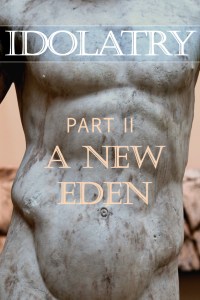
A New Eden cover art 102315cChapter 13 of A NEW EDEN, Part II of IDOLATRY, is now available for those on my “Let Me Know” mailing list.

Please sign up here to receive passwords to my latest novel chapters, and for short stories, new flash fiction, poetry, screenplays, and new edition releases.

Thank you for reading and for all your wonderful Amazon reviews! My fans help keep me fueled.

~ Quent Cordair

Copyright 2016, Quent Cordair. All rights reserved.