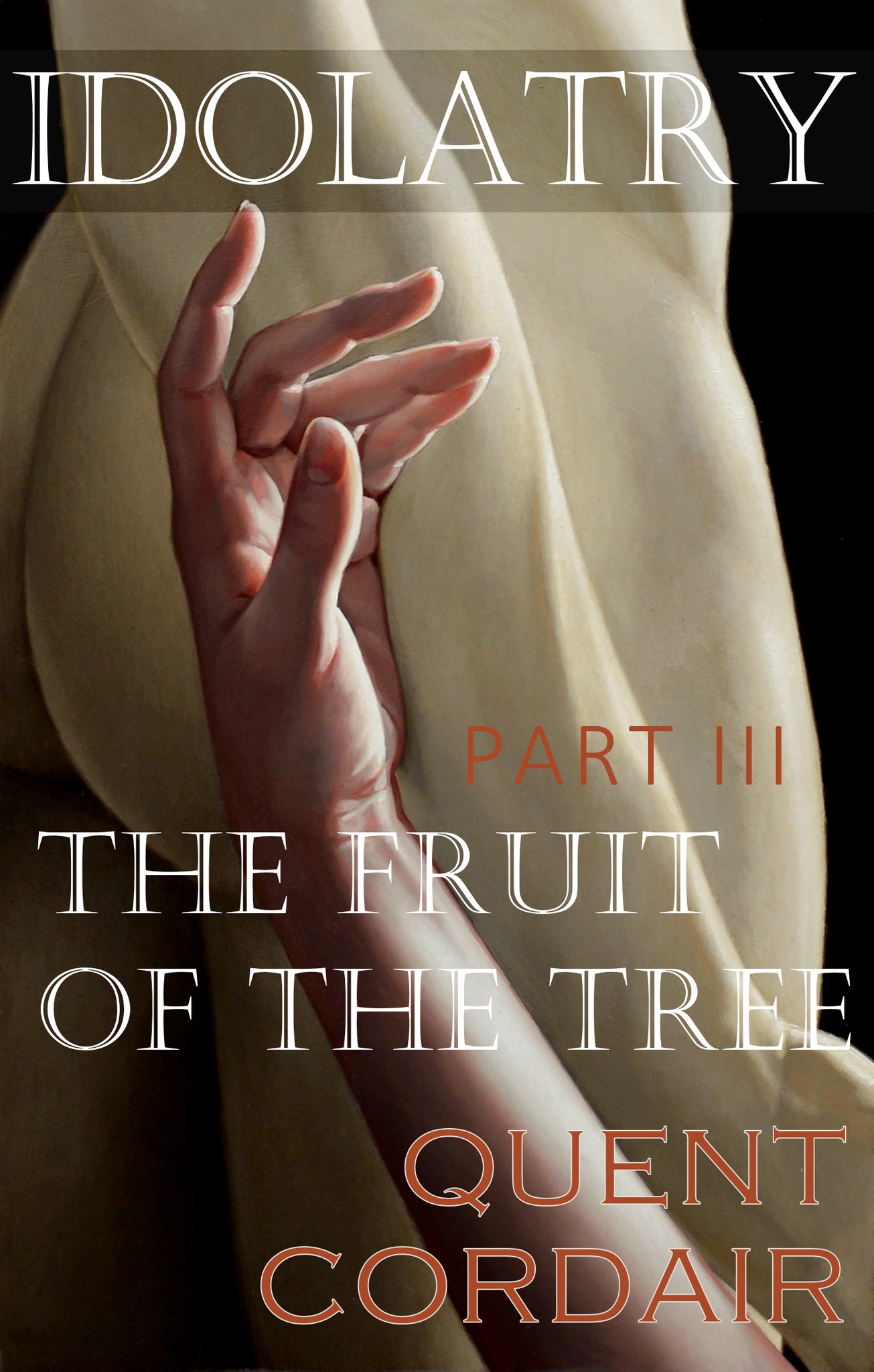
Part III of IDOLATRY is now available!

FeaturedPart III of IDOLATRY is now available!

Journalist Paige Keller returns to Aurum Valley to begin uncovering the secrets of the valley’s history, to the displeasure of those determined to keep those secrets hidden. She discovers the story of Aurelia’s founder, an ambitious young man who returned to the valley to make his home and fortune there, and of a fearless native girl who left her tribe to follow a stranger to a new and unknown life. She discovers the history of a disillusioned immigrant who fled his family’s faith to establish a new religion in the valley, despite suffering a broken moral compass.

In the present, a talented young actress is lured into the lair of a predacious Hollywood producer; the leader of the local church is drawn into a secretive organization with influence deep in the halls of power; a weary environmentalist is inspired to greater sacrifice by an impassioned teenager; a jaded professor is challenged by a precocious new student; an aging sculptress strives to finish her magnum opus while still alive and able; the heir of the valley’s founding family begins building where neither the Church nor the environmentalists want anyone to build—on a hill they all hold sacred.

The Fruit of the Tree is Part III of the acclaimed Idolatry saga, the story of a wealthy young heir and a devout Christian girl who find themselves at the heart of the struggle for the soul of Western Civilization.

NOW AVAILABLE IN PAPERBACK AND KINDLE EDITIONS …
SIGNED AND PERSONALIZED PAPERBACK COPIES NOW AVAILABLE …

~ THE EARLY REVIEWS ARE IN! ~

“Superb third entry in this saga, making for a modern romanticist epic on a par with Victor Hugo and Ayn Rand. The author carefully weaves multiple plot threads and larger than life characters centred on a fictional American town – it’s heritage torn between a fundamentalist offshoot of Mormonism, the rational, life affirming spirit of capitalist entrepreneurs, and post modern leftist sects – encapsulating the two and a half thousand year struggle for the soul of what is now termed western civilisation.” ~ Matthew Humphreys

“Quent Cordair has a great talent for creating compelling characters. Some inspire profound admiration so rarely found in modern literature, others so odious their evil seemed to drip from the page. The Idolatry series is an achievement in laying bare the historical battle between good and evil. Don’t miss all three in the series and you will, like me, be waiting for #4.” ~ John Cerasuolo

“Well worth the wait! The depth and breadth of Cordair’s writing is impressive switching seamlessly between the past and present and with vivid descriptions advancing the story along.
I highly recommend The Fruit of the Tree! I also recommend first reading or re-reading Genesis (book 1) and A New Eden (book 2) in this 5-part saga. There are echoes in The Fruit of the Tree of Genesis and also The Fruit of the Tree follows on directly from A New Eden. I look forward to reading part 4 of the saga which is titled The Tongue of the Serpent.” ~ Godfrey Joseph

“The Fruit of the Tree, the third book in Quent Cordair’s Idolatry series, drew me even deeper into his centuries-spanning philosophical war between good and evil—between lovers of life and those who seek to destroy that love. This volume brings together questions left unanswered in books one and two and moves the epic conflict closer to a climax. If you don’t fall in love with Paige by the end of this book, you definitely need to “examine your premises.” The main characters introduced in book two are more fully developed, and multiple side stories emerge, all contributing to the central theme. Aurum Valley is becoming ground zero in this epic battle of opposing philosophical forces. Now I have to wait in eager anticipation for book four.” ~ Steve McBride

5.0 out of 5 stars ~ Beautiful Writing

“This book brought me straight back into Aurum Valley with its history, mystery, and slow-building tension that this series does so well. Please know that reading the earlier books in the Idolatry series is needed to fully appreciate The Fruit of the Tree. The writing is gorgeous and super descriptive. The way each storyline unfolds makes the whole valley feel alive in a way that’s almost eerie. Paige’s character arc really stood out to me this time. Her drive to dig up the truth, even when it puts her in danger, gives the book a steady heartbeat to follow.

“I also loved how the valley’s history slowly shows up through the story itself. The way those pieces surface adds intrigue to everything happening now, especially with the Church, the founding family, and all the behind-the-scenes power plays. Every character has something going on, and even the smaller side stories end up factoring in a huge way.

“By the end, the mystery is thicker than ever, now that I’ve got some answers to questions from the previous book (A New Eden) and even more new questions. It’s one of those books where I finished a chapter and just sat there like… okay, now I need the next part immediately. I’m invested in this series and can’t wait for the next one!” ~ Kim Bromberek


NOW AVAILABLE IN PAPERBACK AND KINDLE EDITIONS …
SIGNED AND PERSONALIZED PAPERBACK COPIES ARE NOW AVAILABLE …

Don’t let it go

When the many are punished for the sins of the one or the few, individualism dies another death. Moral, principled justice – real justice – requires that each and every individual be judged and treated individually, on their own personal actions and words, and on their own alone. Bigotry and tribalism are worse than lazy: they’re evil and unjust, earning only more and worse of the same in turn. Nativism and racism are civilization killers, innocence killers. America was designed for individuals, for individualism. Our country was built on individualism. We’ve thrived and prospered on treating individuals individually rather than on their place of birth or the color of their skin. Don’t let it go.

The March

The March

How meekly march the millions
To the statist’s steady drum;
How passively they plod along,
All singing the same song:
Left, right, left, right,
To glory days ahead;
Left, right, left, right,
We’ll go where we are led.

How malleable are the masses
Melted in the master mold,
All tribal tied, wings kept clipped,
From cradle to the crypt:
Left, right, left, right,
We won’t stray out of line;
Left, right, left, right,
Together we’ll be fine.

How blind they go with blinders,
Seeing only what they’re shown;
How deaf they go to strident clones
With scripts and megaphones:
Left, right, left, right,
Divided we would fall;
Left, right, left, right,
Each one is one for all.

How silenced the dissenters
Shuffling towards the killing wall;
The gutters thick with viscous red
Are always needing fed:
Left, right, left, right,
Long trenches being filled;
Left, right, left, right,
Come spring we’ll all be tilled.

How deadly aim the rifles
From the towers high above;
The gates are locked, the keys are thrown,
But how could they have known?
Left, right, left, right,
Around the yard we turn;
Left, right, left, right,
When will we ever learn?

~ Quent Cordair
2025

The Black-Holed Soul

The fawning of a million stars
Won’t sate the black-holed soul;
The unfilled need for self-esteem
Devours its diamonds whole.

The brightest suns are fed feet first,
Into the maw they go,
While vacuum’s vice slow-squeezes life
From those prostrating low.

The fearful ones come proffering praise,
So desperate for reprieve,
Some dragging offerings to the mouth,
While swearing they believe.

But in they go by ones or tens,
Sucked in without a kiss,
Around the tongue and swallowed down,
Into the void’s abyss.

~ Quent Cordair
3/2/2025

Out of the Blue

Out of the blue and into the red;
Bureaus are razed for czardoms instead;
Infidels flung on the flag-draped pyre;
Out of the frying pan, into the fire.

Yesterday’s profiteers lined on the wall;
Blindfold executives jeered as they fall;
Cronies and troubadours flock to the court;
Poets and publishers shift to comport.

Tariffs for all who won’t dance for the clown;
Papers are checked by the new tribe in town;
A republic unkept, one best kiss the ring;
The president’s dead, long live the king.


~ Quent Cordair

Silenced

From the river to the sea, they cried,
This land it must be free.
From the river to the sea, they screamed,
What we demand must be.

The Jordan’s banks will overflow
With crimson current high,
Awash with dead unto the Dead,
Till Galilee runs dry.

From the river to the sea, they cried,
We righteously require
That those within who dare to stand
Against us must expire.

For others bound to other books
Can tolerate no choice;
They must be free to kick and kill,
To throttle every voice.

And so it was, it came to pass,
From the river to the sea,
Once champions of the gunning thugs
Were marched and put to knee—

Lined on the shore, the silenced cried,
Bowed down, awaiting shot—
The river fed, the sea turned red,
The floating left to rot.

~ Quent Cordair

“Silenced,” Copyright 2024, Quent Cordair. All rights reserved.

The Village Dogs

FeaturedThe Village Dogs

Let the dead bury the dead,
Let the wounded heal behind,
Let the cowards run from courage,
Let the deaf lead on the blind.

Leave the schemers to their scheming,
Leave the plotters to their plots,
Leave the sheep to follow shepherds,
Leave the spiders spinning knots.

Leave the gullible to liars,
Let the liars fear the truth,
Leave the power-hungry preying
On each other, claw and tooth.

Leave the tribal drummers drumming,
Cannibals to eat themselves,
Leave conspiracists conspiring
With the cans on empty shelves.

Leave the fantasies to mystics,
Let the preachers point with scorn,
Leave the critics to their picking
While the clowns keep shucking corn.

Leave subjectivists judgmental,
Leave intrinsicists their airs,
Leave the dreamers to their dreaming,
But invite the one who dares.

Fix your eyes on the horizon,
Take your bearing, plot your course,
Set the village dogs to barking,
Load your gun, spur your horse.

~ Quent Cordair
Copyright 2023

The Federal Death Agency

This one is for Andrew and Olivia. Having lost two dear ones to cancer over the past two days—a good friend on Sunday, a treasured performing artist yesterday—I promised that today, in their honor, I would “rail against the ideas and premises that have kept cancer alive, and against those who support, defend, and further such ideas.” Here comes the railing:

The FDA is truly and accurately, without exaggeration, the “Federal Death Agency.”* It’s the Federal Death Agency, the Federal Suffering Agency, the Federal Life-Shortening Agency, the Federal Disease & Sickness Prolonging Agency, the Federal Shackling & Prohibition of Desperately Needed Medicines & Procedures Agency. The FDA, if there were full truth in advertising, would be flying the Skull & Crossbones over their headquarters daily. The incalculable measure of death, suffering, pain, illness, and misery inflicted by this one agency alone is staggering.

And yet the agency itself is not the real problem. The agency is but a predictable, inevitable, logical symptom of the underlying disease, and the cause of that disease is both wholly self-inflicted and wholly curable. The cause of the disease, of which the FDA is a symptom, is 100% man-made. That man-made cause could be cured and eradicated immediately, could be destroyed forever, today—but it won’t be, not today, not tomorrow, not for many years to come, because the majority of men and women are so addicted to the cause, so vested in the cause and dependent on it, they would rather suffer and die themselves than face the responsibility for supporting and defending it. They would watch their own loved ones suffer and die before they would question, examine, reject, and replace the cause of that suffering and death with the only viable alternative—an alternative which already exists. Yes, the cure for the disease, of which the FDA and its horrific effects are but a symptom, already exists.

No one and no agency has the moral right to stand between an individual and his choice of any and every medical option available to him, especially when his life and health are at stake. No one and no agency has the moral right to stand between the inventors, producers, and providers of medicines, medical equipment, and medical procedures, and the patients who desperately want and need those products, procedures, and services, those who are willing, by their own judgment and moral right, to risk trying whatever available option in the face of the alternatives.

Those who believe and hold otherwise, that humans are by nature incapable of making their own healthcare choices, or shouldn’t be allowed to, for altruistic reasons, are operating on the very premises that caused the creation of that murderous entity which is the FDA. Those who hold that the individual’s own healthcare choices should and must be subordinated to the “greater good,” that the good of the individual should be sacrificed to the good of the less intelligent, the less educated, the “less fortunate,” are operating on the very premise that results in the unnecessary suffering and premature death of thousands, indeed millions, including the unnecessary suffering and death of those nearest and dearest to them.

Yes, if not for the philosophical premises of altruism that support the FDA, premises held by most Americans left and right, cancer, along with so many other diseases, would already be well behind us. Andrew Bergman, Olivia Newton-John, and countless others would still be with us today, happily living their lives. For those fortunate enough not yet to have succumbed to Andrew and Olivia’s fate, those who might still believe that the existence of the FDA is in your best interest—please do yourself a favor: think again. Or as Ayn Rand would say, check your premises. Discover the rational, life-saving alternative.

FDA delenda est.

***

*Credit to Harry Binswanger for the accurate epithet. See the article “The FDA is the Federal Death Agency” for further consideration. For the proper, principled approach to defending private medicine, see https://ari.aynrand.org/issues/government-and-business/health-care/ .

In light of Roe v. Wade

In light of Roe v. Wade

In light of SCOTUS overturning Roe v. Wade, I offer the following from A New Eden, Part II of Idolatry:

*****

Sophia’s white-gloved hands were lying in her lap, holding the Easter lilies she had taken from the arrangement next to where the casket had been.

“Keep driving please, Sam.”

Sam kept driving, passing the turnoff to the garage, continuing at a measured pace down the narrow lane, over the rolling grassy hills and through the shaded woody vales, all the way to the back of the estate, to where on the crest of the last hill stood the majestic red oak, where from the oak’s high branch hung the swing.

Sophia could still hear the squeals of delight as Roger or Aaron would push Julie. “Higher! Higher!” Julie would demand, her bare legs and feet reaching for the sky, her head thrown back in abandon as she arced out and up, over the falling slope beyond, over the easterly flatland, finding weightlessness in the open sky.

“Momma, I’m flying. . . .”

As had become their custom, Sam stopped the car fifty yards short. Sophia walked alone the rest of the way. She stood now before the swing, staring blankly at the empty wooden seat as it creaked and rocked gently in a passing lullaby of a breeze. Standing here, she would always be able to hear her daughter’s floating, soaring laughter. The memory, a mother’s sacred blessing, was now her burden forever to bear. Next to the swing was the granite stone, flush in the ground. On the stone’s polished face, unmossed and unweathered, the engraved letters and dates were too fresh, too young, too new. They always would be.

Almost from the moment Julie became a teenager, the laughing had ceased and the struggle had begun. Her driving desire for independence pushed against all restraints—reason and sensibility be damned. Missed curfews, angry arguments, stony silences, hurled accusations, slammed doors. Sophia wasn’t terribly surprised—her daughter had always been willful and independent, as Hales tended to be—yet she was disappointed. She had hoped to be spared. Aaron, through his teens, had never caused the slightest problem or concern. Julie lashing out was wounding, to be sure, but Sophia endured, knowing they would get through it somehow, as countless mothers and daughters through the ages had gotten through such phases. With all the sympathy and empathy she could muster, she kept the relationship tacked and pinned and stitched together through the strains, impasses, bitterness and tears, knowing that the two of them would survive and overcome, eventually. They were strong. They loved. They trusted each other. They were honest. Sophia would be there, waiting on the other side for her healthy, happy daughter to re-emerge. It would only be a matter of time, of perseverance. . . . But it required more patience than Sophia ever imagined she would have to find.

Then, in the middle of Julie’s fifteenth year—sooner than Sophia had hoped or expected—Julie’s demeanor changed. Indeed, her entire personality changed, practically overnight.

She had met a boy from the Church who convinced her to attend a youth service with him. Within a week, she declared herself a Christian, a redeemed Lamb of the Flock—saved. At meals she effused about Jesus’ fathomless love and God’s grace, which was not only her own personal salvation but the salvation of the whole world. Her black jeans, her formless, dark sweatshirts and her ragged sneakers were replaced by conservative knee-length dresses and low-heeled shoes and sandals. Her black hair with the rebellious red streak was dyed back to the original brunette. Her pixie cut was left to grow back out. Her makeup and jewelry were discarded—Sophia quietly rescued a set of diamond studs and a string of pearls from the garbage.

Her mother had welcomed the change with only minimal unease. At the dinner table, Sophia preferred the exhortations and enthusiasm for all things Flock to the seething and heavy silences punctuated with spewed anger. Yet she couldn’t shake the feeling that her daughter had jumped out of the frying pan and into—not the fire, but a vat of warm, sugary, liquid gelatin. The overt kindnesses and effervescent expressions of love for everyone and everything seemed to Sophia little more genuine or justified than the anger and venom. How long would this new spiritual high last? How long would the new medium buoy Julie up? How long before the gelatin would begin to solidify around her? How long before the spell broke?

Less than six months, as it turned out. In the middle of the school year, Julie insisted on transferring from her private school to the Flock’s academy. Roger had refused initially, but with Sophia’s patient persistence and urging, he finally acquiesced.

At the beginning of the summer break, Julie had travelled with a busload of Flock youth to a Church retreat at a campground in southern Idaho. When she returned, the effervescence and effusiveness had vanished. She wouldn’t talk, she wouldn’t open up, no matter what Sophia or Roger or Aaron tried. Once again, she shut everyone out. Through the locked bedroom door, her pillow-muffled, retching sobs could be heard late into the night. Surely, Sophia guessed, the problem was now a boy, perhaps even a girl—but she could get nothing out of her daughter.

After a few days, Julie pulled herself together enough to continue attending church services and activities. She donned a brave smile but remained subdued. A few weeks later, Sophia came home at midday to meet with the electrician about the pool heater. Julie’s book-bag and purse were on her bed. Julie herself was nowhere to be found. On a mother’s hunch, Sophia drove to the back of the property.

Julie was there on her swing, rocking herself gently, head leaning against one of the ropes. After a forlorn search of her mother’s eyes, the dam finally broke and the despair poured out. Julie was pregnant, of course. It had been a Flock boy, of course. She wouldn’t say which. She had gone to a church counselor that morning. He had informed her in gentle but firm terms that her only option was to have the baby—unless she wanted to lose her soul and go to hell for the murder of one of God’s children. Still hardly more than a child herself, Julie was distraught, devastated.

Sophia was heartbroken for her daughter—and furious, not at Julie’s actions, but at the Church’s response. She pried the name of the counselor out of Julie and arranged a meeting. The counselor was polite and empathetic, but he wouldn’t back down. He insisted he would have told the same to his youngest daughter, a year younger than Julie: murder was murder. There was now a child of God in Julie’s womb, and Julie’s duty was to carry her God-given burden, to give birth, and to raise the child to adulthood. Julie’s life was no longer her own. Other young mothers had managed it—Julie would manage it as well. Fortunately she had Sophia to help her. God didn’t promise that our lives would be easy, only that it was our duty to carry whatever cross he gave us to bear on this earth, for which we would be rewarded in heaven.

Sophia next stormed the parish, but Reverend Lundquist was away on a tour of the Flock’s missions in Central America. He couldn’t be reached, or so his secretary insisted. Sophia’s daily messages went unanswered.

For two more agonizing weeks, Julie struggled. She struggled with her conscience and with her hopes for her future, with her hopes for her life and for her soul. When Julie allowed it, her mother was at her side. In the end, with her mother’s approval and escort, she made an appointment at the clinic and had the abortion.

The drive home had been in a thick silence. Sophia reached out to hold her daughter’s hand. Julie pulled away, clasping her own hands in her lap, staring out of the window.

She stopped going to church. Sliding back into her darkness, she began palliating her shame and grief with food—any and all food she could get her hands on, any she could keep down. After gaining thirty pounds, she suddenly stopped eating and lost all the weight—and then more weight. She returned to church and went to a different Flock counselor, this time a woman, who told her that God would forgive her, but only if she were truly and genuinely remorseful and ashamed for her grievous sins, for having sex out of wedlock and for murdering her unborn child. Given the severity of the transgressions, the counselor prescribed a six-month regimen of weekly personal and group counseling and prayer, supplemented by five hundred hours of voluntary duty in the orphanage, taking care of the babies that other young mothers, following God’s will, had given birth to. Julie asked her mother later what had happened to all the mothers of those babies. Sophia could only guess. A couple of them, she knew, had worked at the resort, but they had long since disappeared from the community.

Long talks between mother and daughter and longer silences followed. Julie regretted having slept with the boy, or more accurately, having done so without protection, but she couldn’t bring herself, as hard as she tried, to feel wrong for having done so. She was chagrined at having made what she considered to be a serious mistake, but she simply was not ashamed of it, and she couldn’t make herself feel an emotion she didn’t feel. The act of lovemaking, she told her mother, had seemed neither wrong nor unnatural. She had been following a desire that God surely had given her for a reason. She had felt terrible about the abortion but she couldn’t bring herself to feel genuinely guilty for that either, given the alternative, which was simply unthinkable to her—and she was too honest to fake a remorse that didn’t and couldn’t exist.

She attended another few church services. Of course they knew. Everyone knew. One of the girls working at the clinic probably had a friend of a friend who was a Flocker. The only secrets in Aurum Valley were the ones nobody cared about. As she told her mother afterwards, she felt as if the whole congregation were watching her. Many had gone out of their way to express sympathy and understanding, seeming almost grateful for something they wouldn’t come out and name, as though they were somehow relieved at what she had done—that she, Julie Hale, was a sinner—that she, of all the girls in the valley, had sinned.

Sophia accompanied Julie to church the next Sunday, and she experienced it too. She was approached and greeted eagerly with a fresh, enthusiastic acceptance, as though the Flock members were appreciative that Sophia and her family had been brought down to a status as low—perhaps even lower—than their own. God had revealed that the Hales, too, were subject to human fallibilities and carnal hungers; their weakness and true nature had finally been revealed; they had been brought down to a position from which only God could raise them up again, up to the more humble plane of the Flock.

Julie lost another twenty pounds she couldn’t afford to lose before waking in the hospital with an IV in her arm, having fainted in her room while the rest of the family ate dinner. As her daughter was being released, three days later, Sophia had choked back tears on catching a glimpse of Julie’s back when she was changing into her street clothes. She looked like a concentration-camp victim, all skin and bones. It was less than a month later, on another spring day as faultless and beautiful as this Easter afternoon, that the housekeeper found Julie hanging in her bedroom closet, the belt from her Procession robe around her neck.

Julie had never had a chance to wear the robe. She had been so pleased and excited when she bought it, months ahead of time. She was so looking forward to her first Procession. Sophia had left the robe hanging in the closet.

*****

Quent Cordair, A New Eden, Part II of Idolatry, 2016
https://www.amazon.com/New-Eden-Idolatry-Book-ebook/dp/B01J2KPSNW